“Play Me Something Quick and Devilish” explores the heritage of traditional fiddle music in Missouri. Howard Wight Marshall considers the place of homemade music in people’s lives across social and ethnic communities from the late 1700s to the World War I years and into the early 1920s. This exceptionally important and complex period provided the foundations in history and settlement for the evolution of today’s old-time fiddling.
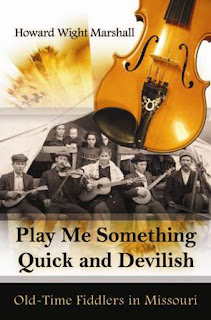
My inspiration has always been the people, stories, and grass roots history behind the music people make. I learned to appreciate all kinds of music, and admiration of my grandfather, Wiley Marshall, has always been a driving force behind my interest in “the fiddle;” he was the principal fiddler in our family when I was a child, but there have been fiddlers in the family in central Missouri since the 1830s.
I began playing traditional music as a teenager in the 1960s in the “Folk Music Boom.” (At the same time, I was devoted to modern jazz.) After coming out of the military in 1966, I returned to college in Missouri and soon became dedicated to recording and understanding, as well as performing and listening to, “old-time music.” In grad school at Indiana (Folklore Institute), I concentrated on material culture and folk architecture and my career took me to museums, the Library of Congress, Kansas State U. and finally to the University of Missouri. My principal pastime through the years, however, has been performing and studying traditional music. This book and CD, Play Me Something Quick and Devilish, is the result of a life devoted to traditional music and grassroots culture.
Q: What did you learn from writing this book?
Several aspects of the world of traditional music have barely been scratched by researchers in Missouri. These aspects include such areas as African American fiddlers and their legacy today, the role of fiddlers with Native American ancestry (of which there are many in Missouri), the so-called brass band movement after the Civil War and its relationship to fiddling, musical literacy in the late Victorian Age, the role of immigrant German-speaking music teachers in small towns, and the role of Tin Pan Alley compositions in the traditional fiddlers’ repertoire; these and other seldom-studied subjects are explored in Play Me Something Quick and Devilish.
Q: What is your background in music? Does it relate to your background in architecture or are they two separate passions?
I am from a musical family; children were expected to play a musical instrument or sing in choirs (or both). Music is considered a part of young people’s full education and adds greatly to their lives later on. In my family, all kinds of music are enjoyed and performed. As a child, I tried my hand at clarinet, piano, and cornet; I was a poor music student but I managed to participate in school bands as a back-row cornetist. I also participated in school and church choirs and enjoyed this tremendously. I discovered that I was primarily an “ear musician,” and I had a knack for folk music and learning from watching and listening to others (rather than from music lessons and formal training). I began playing tenor banjo, uke, and guitar in high school and performed popular folk music of the Sixties. While stationed in San Diego in the Marine Corps, my vistas were considerably broadened, and I began a long trek to become proficient in bluegrass music, first on guitar and then on mandolin. This continued after I returned to college in Missouri in late 1966, and at this time I learned to play Missouri-style “frailing banjo” and began to be motivated to learn to play “old-time” fiddle music in the style of central Missouri. I began to have enough courage to perform in public on the violin in the middle 1970s.
Vernacular architecture and traditional music are patches in the same patchwork quilt of American folk tradition, artistic expression, and grass roots history.
Q: How different is old-time fiddle music now compared to a hundred years ago?
In many ways, old-time fiddling today is in great shape, in terms of its acceptance and popularity various social classes and communities. One crucial change is the tremendous popularity of learning to play “fiddle music” with the aid of newer learning methods, such as the Suzuki Method; this means that many violin students are being encouraged to play fiddle tunes as well as their classical assignments, and this is helping to erode stereotypes and prejudices among the classical community about old-time fiddling. Another great development is the rapidly expanding participation of women and young girls in old-time fiddling – once generally considered to be “men’s work.” Yet another change is the lessening of conservative Protestant groups’ bias against musical instruments in church; the violin is still known as “the devil’s instrument,” but the old ban on instruments in certain conservative churches is far less seen than in former times.
Q: What popular musicians give you inspiration?
For the world of traditional American fiddling, I have been tremendously influenced (mainly through my fiddle mentors) by several giants of fiddling and commercial recordings, such as bluegrass fiddler Kenny Baker; Arthur Smith; Howdy Forrester; Robert (Georgia Slim) Rutland; and Benny Thomasson. I would say that those are the principal “nationally known” professional fiddlers who have influenced my fiddling in terms of performance style as well as repertory. Two other, lesser-known, fiddlers who made records with global exposure are among my favorites: the Irish fiddler John Doherty, and the Indiana fiddler John (Dick) Summers.
Q: As a musician, do you have any future recording projects planned?
A documentary and teaching DVD is being considered with Voyager Records on old-time “fiddle seconding,” Missouri style. I am, sad to say, one the few fiddlers who still do this traditional kind of fiddle accompaniment. Young people, when exposed to it, seem interested in learning, and we feel it is a tradition worth sharing and helping conserve.
Being planned is another fiddle CD of my own, mostly of Missouri tunes, to follow the 1998 Voyager CD, Fiddling Missouri. www.voyagerrecords.com
I continue to develop fiddle CD projects as a Voyager Records producer. To date, I’ve produced a half-dozen projects with Voyager featuring Missouri fiddlers.
Q: What will your next book be about?
Play Me Something Quick and Devilish covers the early times, from the eighteenth century French villages through the nineteenth century and to the World War I years and 1920s. I am working toward a sequel, which would bring the saga of traditional fiddle music through the twentieth century and down to the present day. There would be chapters relevant to modern times, such as chapters on the evolution of the fiddle contest scene, swing fiddle, bluegrass, and the recording and radio industries.

