Showing posts with label humor. Show all posts

Wednesday, November 6, 2013

Book Spine Poetry


The book spine poetry sensation is sweeping the nation, and we here at the University of Missouri Press could not resist trying out this creative literary medium. Inspired by the earlier postings of Publishers Weekly and the Duke University Press, UMP has been searching its shelves to find the best titles that would help us author a few book spine poems of our own:


Insane Sisters

They Raised Me Up

Call Me Tom

A Fatherless Child

An Unplanned Life


Wondering about the future...

 
A Semblance of Justice

Long Odds

The Opinions of Mankind

Paradigms of the Past

The Promise of Progress


This one is a bit sad...

The Broken Nest

The Art of Grit

Empty Bed Blues

The Plain Language of Love and Loss

The Consolations of Ambiguity


It's easy to lose sight sometimes of just how much we owe these men and women...

Soldiers and Statesmen

The Forgotten Generation

Beginning the Quest

From Home Guards to Heroes

Tomorrow Will Be Better


Acting Immortal

Talking Razzmatazz

Stratagems to Uncover Nakedness

Held for Questioning

Where Laughter Stops


How well do you really know yourself?


The Elusive Self

Near at Hand

Telling the Untold Story

Above Time

The Way We Know in Dreams


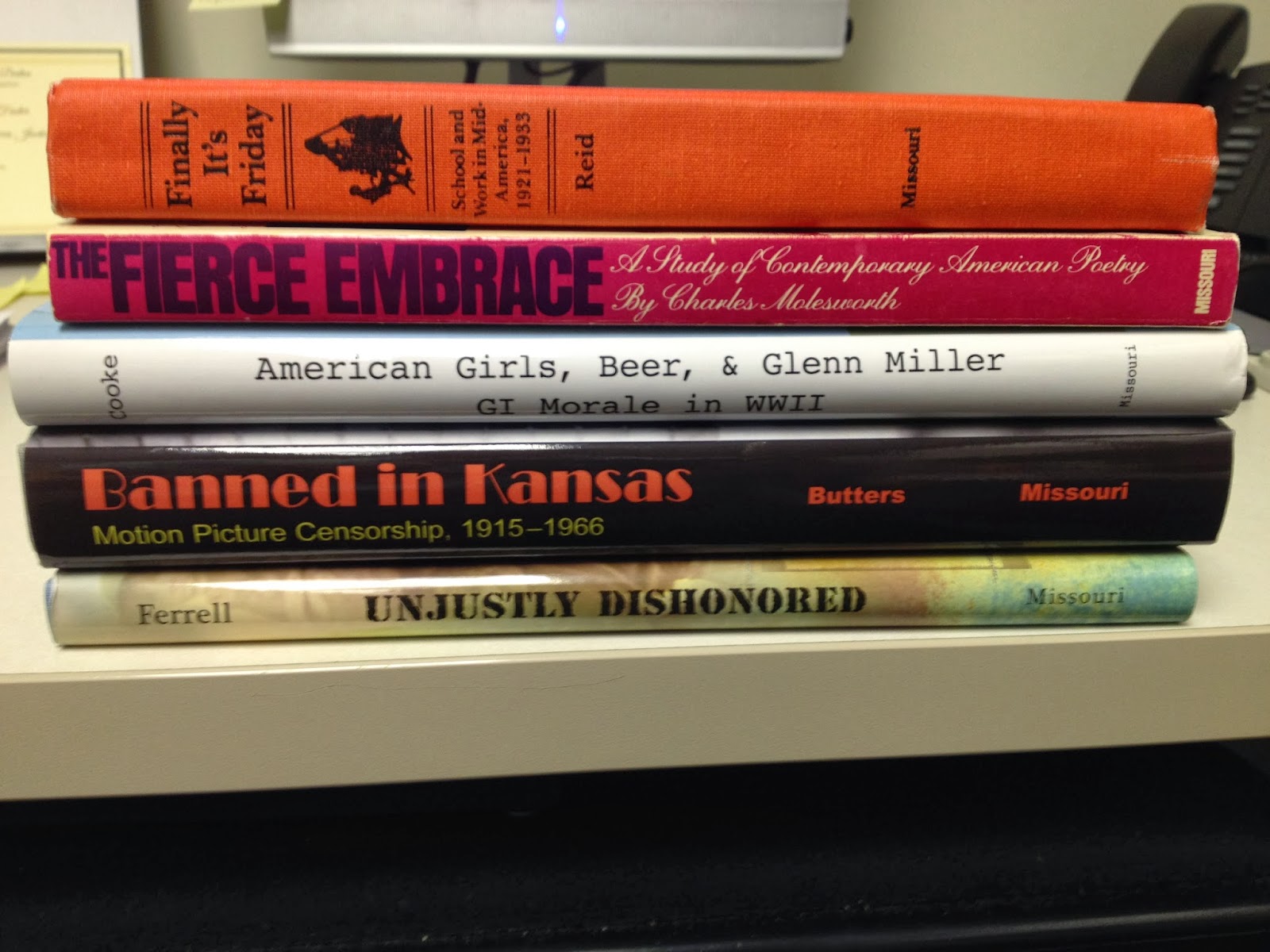
We all know that Friday feeling...


Finally it's Friday

The Fierce Embrace

American Girls, Beer, & Glenn Miller

Banned in Kansas

Unjustly Dishonored


If you have any book spine poetry creations of your own, please let us know! We'd love to share them.


Monday, July 22, 2013

The Mark of the Twain

I've lived in Missouri for twenty years, and I've never read a Mark Twain book. I realize this is near-blasphemous to say. I still don't know how I squeezed through the Missouri public school system without laying a finger on a well-worn copy of Huck Finn. To be clear, this is not a point of pride for me; I'm downright ashamed.

Instead of actually reading his books, I've spent most of my life wondering if Mark Twain would be a cool guy to hang out with. It's probably just a consequence of the state of photographic technology around the turn of the twentieth century, but to me, Mark Twain always looks like some forlorn steamboat captain who strokes his mustache and stares wistfully off into the distance. You know, the type of guy who stands by the chip bowl at a party and accidentally dips his hand in the salsa for too long because he's not thinking about the chips; no, he's thinking about something deeper than that. Now, this portrait of Twain doesn't exactly paint him as the party god he'd probably rather be remembered as, but this is exactly the kind of person I like to be around. Mark Twain and I likely would have gotten along just fine.

But I've recently been reconsidering my lack of actual Twain knowledge. Working at the University of Missouri Press tends to do that to people, I think. The Mark Twain & His Circle series published by the Press explores facets of the writer's life I didn't even know could be studied: his thoughts on living in the city, the use of gender play in his work, even hypothetical conversations between Twain and the hottest philosophers of the modern world. And surprisingly, looking at all these Twain books for twenty hours a week sparked my interest enough that I picked up a copy of The Adventures of Tom Sawyer at the bookshop next to my laundromat the other day.

The Mark Twain & His Circle series is a nearly twenty-strong team of books on the beloved humorist and his work. Below are just a few offerings from the series, but Mark my words: you will find a Twain tome in here that's to your liking.


The Jester and the Sages approaches the life and work of Mark Twain by placing him in conversation with three eminent philosophers of his time—Friedrich Nietzsche, Sigmund Freud, and Karl Marx. Unprecedented in Twain scholarship, this interdisciplinary analysis supplements the traditional appreciation of the forces that drove Twain’s creativity and the dynamics of his humor by exploring how his reflections on religion, politics, philosophy, morality, and social issues overlap the philosophers’ developed thoughts on these subjects.


In Mark Twain: The Fate of Humor, James M. Cox pursues the development of Mark Twain’s humor through all the forms it took from “The Jumping Frog” to The Mysterious Stranger. Instead of seeking the seriousness behind the humor, Cox concentrates upon the humor itself as the transfiguring power that converted all the “serious” issues and emotions of Mark Twain’s life and time into narratives designed to evoke helpless laughter. In those sudden moments of pleasurable helplessness, we glimpse the great heart of a writer who imagined freedom in the slave society of his youth and discovered slavery in the free country of his old age.


Delving into the psychological aspects of metaphor to reveal Twain’s attitudes and thoughts, John Bird shows how using metaphor as a guide to Twain reveals much about his composition process. From “The Jumping Frog” to the late dream narratives, Mark Twain and Metaphor considers Twain’s metaphoric construction over his complete career and especially sheds new light on his central texts. He reconsiders “Old Times on the Mississippi” as the most purely metaphorical of Twain’s writings, goes on to look at how Twain used metaphor and talked about it in a variety of works and genres, and even argues that Clemens’s pseudonym is not so much an alter ego as a metaphorized self. In addition to dealing with issues currently central to Twain studies, such as race and gender, Bird also links metaphor to humor and dream theory to further illuminate topics central to Twain’s work.


Mark Twain in Paradise is the first comprehensive study of Samuel Clemens’s love affair with Bermuda, a vivid depiction of a celebrated author on recurring vacations. The book sheds light on both Clemens’s complex character and the topography and history of the islands. Donald Hoffmann has plumbed the voluminous Mark Twain scholarship and Bermudian archives to faithfully re-create turn-of-the-century Bermuda, supplying historical and biographical background to give his narrative texture and depth. He offers insight into Bermuda’s natural environment, traditional stone houses, and romantic past, and he presents dozens of illustrations, both vintage and new, showing that much of what Mark Twain described can still be seen today.


A century after Samuel Clemens’s death, Mark Twain is still thriving. His books are widely cherished, and fans flock to his homes in hopes of learning more about the first true American writer. Literary historic sites have long pinned their authority on the promise of exclusive insight into authors and texts, but Hilary Iris Lowe encourages readers to think critically about this celebration of Clemens. As tempting as it is to accept the authenticity of Clemens’s homes, Mark Twain’s Homes and Literary Tourism argues that house museums are not reliable critical texts but are instead carefully constructed spaces designed to satisfy visitors.


Searching for Jim is the untold story of Sam Clemens and the world of slavery that produced him. Despite Clemens’s remarks to the contrary in his autobiography, slavery was very much a part of his life. Terrell Dempsey has uncovered a wealth of newspaper accounts and archival material revealing that Clemens’s life, from the ages of twelve to seventeen, was intertwined with the lives of the slaves around him. Carefully reconstructed from letters, newspaper articles, sermons, speeches, books, and court records, Searching for Jim offers a new perspective on Clemens’s writings, especially regarding his use of race in the portrayal of individual characters, their attitudes, and worldviews.